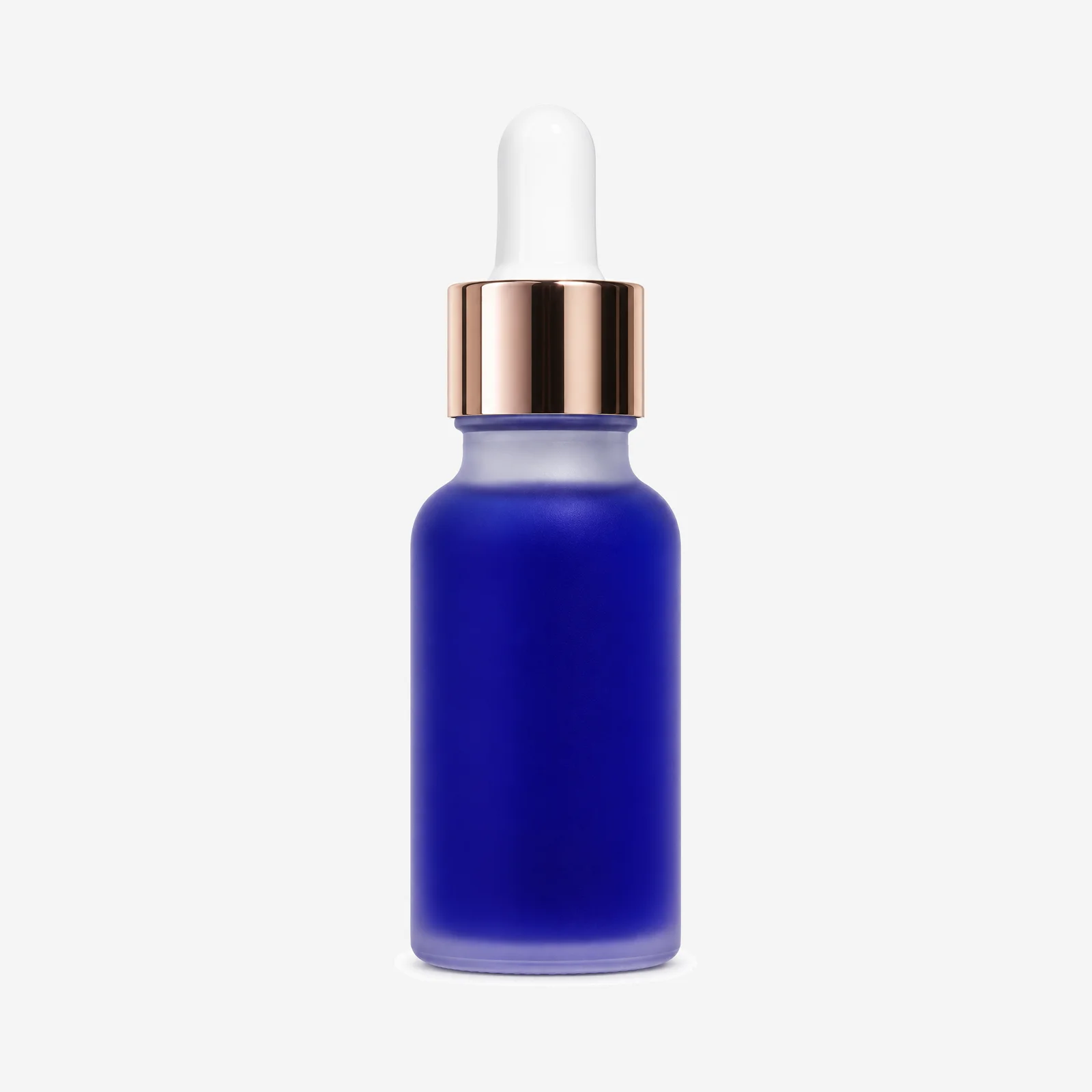
If you've ever seen a skincare serum in an unexpected shade of blue, there's a good chance copper tripeptide-1 is the reason. It's one of the most talked-about peptides in skincare, and one of the most misunderstood. Here's what it is, where it came from, and how to get the most out of it in a simple routine.
What it is
Copper Tripeptide-1 is the INCI name (the standardized name used on ingredient labels) for a small peptide bound to copper. The peptide is just three amino acids long: glycine, histidine, and lysine. That's why you'll also see it called GHK-Cu, after the one-letter codes for each amino acid plus the chemical symbol for copper.
On its own, the peptide is colorless. Paired with a copper ion, it takes on a deep blue.
In cosmetics, it's classed as a skin-conditioning ingredient: it's there to help skin look and feel its best.1
A short history
GHK was first described in 1973 by Dr. Loren Pickart, who identified it in human plasma.2 It made its way into skincare over the following decades, and today it shows up in serums and creams from brands of every size.
Despite that long history, it's rarely the star of a formula. More often it appears near the bottom of a long ingredient list, sharing the spotlight with a dozen other actives.
Why it's blue
The color isn't a dye. It's the copper itself.
Copper ions absorb light at the red-orange end of the spectrum, so the light that reaches your eye looks blue. In general, a deeper blue means more of the copper complex is present, although some products add colorants, so it's worth checking the label.
Once it's pressed into skin and absorbed, it doesn't leave a blue tint behind.
How it helps skin look
Used consistently, copper tripeptide-1 helps skin look firmer and smoother, and reduces the appearance of fine lines.
Like most skincare, it's about consistency rather than quantity. A few drops once a day, every day, will do more than a heavy layer applied now and then.
Using it well
- Apply to clean, dry skin, once a day, morning or evening.
- Use a few drops. Three or four is plenty for face and neck.
- Follow with your moisturizer to seal everything in.
- Patch test first. Try it on a small area of skin 24 hours before your first full use.
- Keep it apart from vitamin C and strong acids, as explained below.
Why the pairing rules matter
L-ascorbic acid (pure vitamin C) and copper react with each other, and the reaction makes both less stable. Strong AHAs and BHAs work at a low pH, which can loosen the bond between the peptide and its copper.
Applying them together means you get less from each product. The fix is simple: use them at different times of day. For example, vitamin C in the morning and copper tripeptide-1 in the evening.
Reading a label
A few things on the box tell you a lot about a copper peptide product:
| What you see | What it tells you |
|---|---|
| Copper Tripeptide-1 | The INCI name for GHK-Cu. Look for this exact name. |
| Its place in the list | Ingredients above 1% are listed from most to least. Closer to the top usually means more. |
| A blue color | A good sign the copper complex is present, unless the list also includes a blue colorant such as CI 42090. |
| A short list | Fewer ingredients make it easier to tell what your skin likes, and what it doesn't. |
How we use it
Our Copper Peptide Serum is built around copper tripeptide-1, with a few supporting ingredients and nothing added for show. Every one of them is listed, with what it's there for, on our Science page.
Sources
This article is general information about cosmetic ingredients. It isn't medical advice. If you have a skin condition or concern, talk to a dermatologist.